There are a lot of "AI is amazing" posts right now (it is), but few of them actually tell you how to use AI effectively. I want to share a project I built this weekend entirely in Claude desktop: a local community website from start to finish.
Forewarnings:
- I'm a heavy user of Claude, so I have a Max plan. I likely would not have been able to do this without it.
- This blog will contain some technical references, but it's meant to showcase how Claude can help those who consider themselves tech-adjacent.
The project: marshallcountyguide.com, a free directory of local businesses across Marshall County, Tennessee. 163 of them across 16 categories, each with its own page, a real database behind it, maps, and the search-engine plumbing that makes a directory findable. Built over a weekend, Saturday into Sunday, and it keeps itself current on its own now.
Here's how the sausage is made:
Claude Desktop, clean slate
If you're unfamiliar: Claude Desktop is one way to use your Claude subscription. You install it locally and it gives you Claude Chat, Claude Cowork, and Claude Code in one place. I find it friendlier than the browser, especially for juggling several conversations at once.
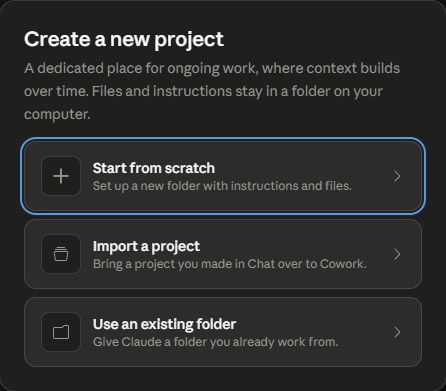
I started by creating a brand-new, empty project in Claude Cowork. That gave me a clean folder I could share across all three tools, and it put me in Cowork on purpose: it has scheduled actions, and I already knew I'd want them later to keep the directory updating itself.
Talk through the plan
From here I just… talked. I gave Claude a plain-language rundown of what I wanted, the goal, the feel, the guardrails, and let the conversation go where it needed to. No code, no structure yet. This matters more than it looks: the conversation is where you catch a bad assumption while it's still cheap to fix.
Here's how the project started:
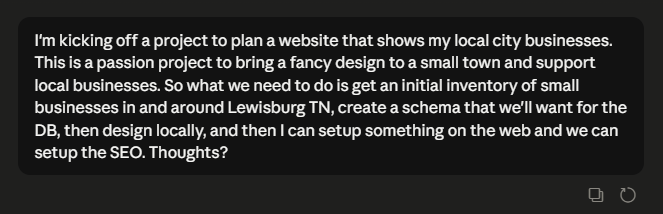
Don't just describe your idea, though. Hand it over and tell Claude to attack it:
- "Pretend you hate this project. What are the weak points? What are we assuming or glossing over? What's the late-stage gotcha?"
- "Pressure-test this spec. Be direct. Accuracy over agreeing with me."
Walking through a specific example helps too, because it forces Claude to step through the project one piece at a time instead of staying abstract. For bigger projects I'll spend hours right here. The handoff is only ever as good as this conversation.
Work from a spec document
Out of that conversation came a spec document, reinforced and battle-tested (okay, maybe not). When I say spec, I mean a Markdown file (it shows up as .md). Think of it as the newer and way more mature .txt file. Once Cowork handed me a final project_plan.md, we were ready for the handoff to the master crafter: Claude Code.
This file is the single most important thing you hand to Claude Code: vague instructions produce vague software, and a written spec is the thing you can check the result against.
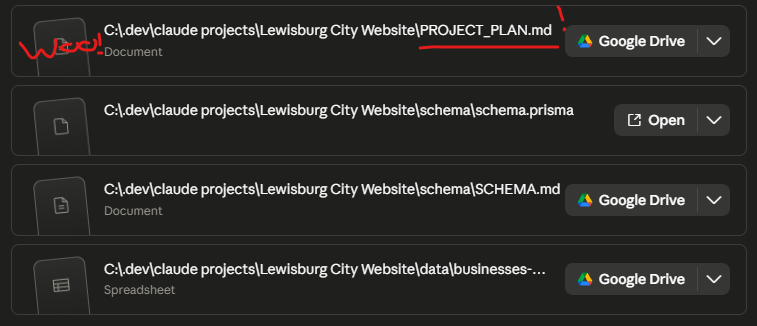
I will say this again, with loud klaxons and alarms going: giving Claude Code a spec document is an absolute rockstar move. This is exactly where all those "my project fell apart" posts begin: someone started asking Claude to code with no guidance at all.
Split work: company research & Claude Code crafting
This is where the juggling started. The handoff itself was almost anticlimactic: I pointed Claude Code at the project folder, told it to read the project_plan.md, and let it go. Then, instead of watching it work, I turned back to Cowork and put it on a completely different job: go find every business in Marshall County.
That research wasn't one magic query. I had Cowork send out multiple feelers: looking for the different types of businesses in the county, then pulling in their details:

That database started life as a plain CSV. Another case of letting the project grow into its tooling: I didn't need a database yet, I just needed somewhere to put the data.
The nifty reality of Claude Desktop: those two jobs had nothing to do with each other, so they didn't have to wait on each other. Claude Code built the empty house while Cowork went out and gathered the furniture. One of me, two tools, both moving at once (realistically, I also had two other ideas I was juggling with Claude Code… it was an intense weekend).
Claude Code & "modes"
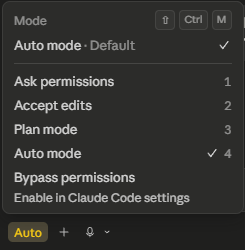
A quick note on modes. Claude Code can run a few different ways, and the one worth knowing is auto. In auto, it behaves like a sharp senior engineer running the project: you give it the goal, it breaks the work into pieces, spins up helper instances (subagents) to work them in parallel, and keeps going until it's done or genuinely stuck.
The flip side is real: auto can do real damage if it goes off the rails. It hasn't happened to me, and that isn't luck. It's because I set the fence in that first conversation, things like never touch the database without asking, never deploy on your own, stop and check before anything destructive. Your mileage may vary (please for the love of all that is holy do not use this on your main company app/repo/filesystem without MUCH more research).
Does it actually work?
Another important step: I had Claude spin up a local version of the site so I could test as it built. I wasn't reading code, I was checking it like a product team would, clicking links and eyeballing the contrast, color, and fonts. At that stage, changes were quick and iterative.
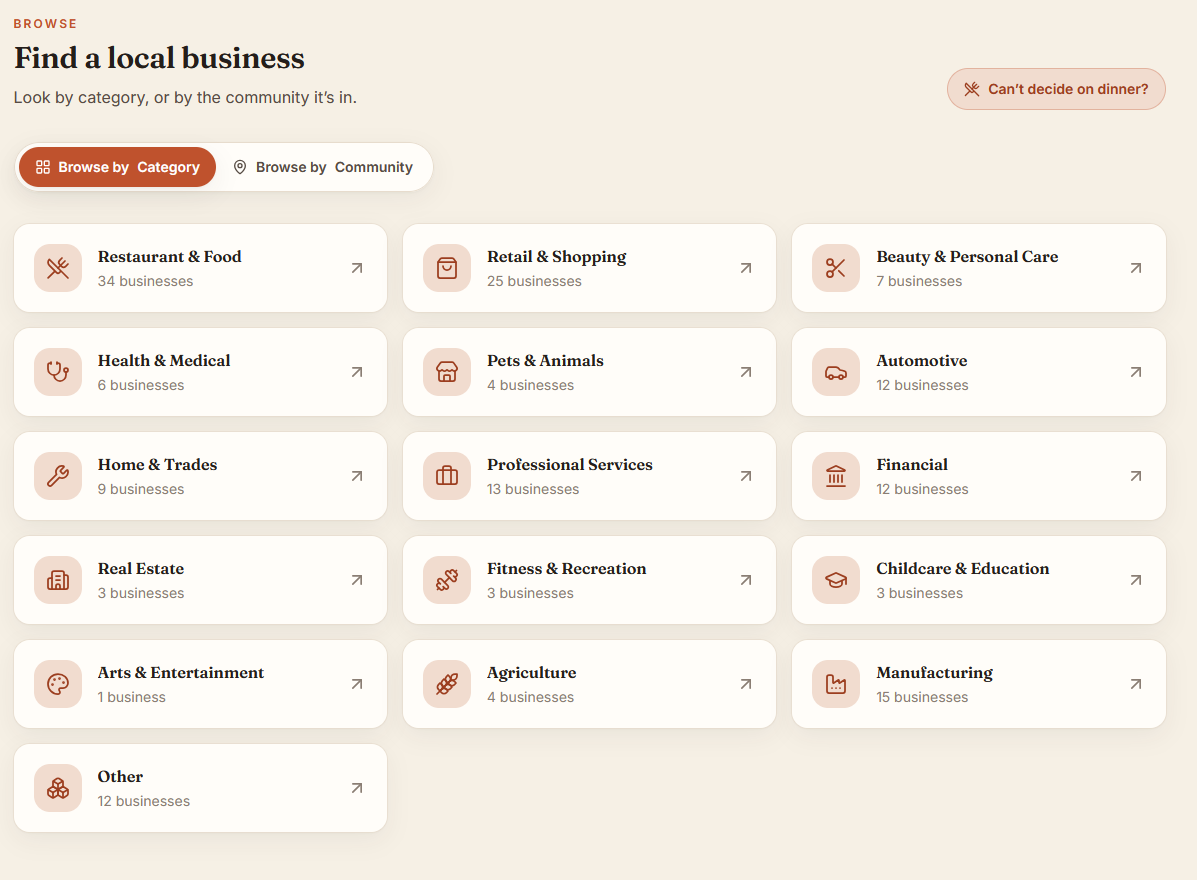
Then there's the half you can't see. A site doesn't show up in search by accident; there's a layer of behind-the-scenes plumbing that tells Google, and now AI assistants, what the site is and what's on it. So before moving on, I had Claude Code wire that in: the standard SEO pieces, plus the newer files that let LLMs read the directory too. Unglamorous, mostly automatic, and the whole difference between getting found and being invisible.
The "technical" part that scares people is smaller than it looks
There's one stretch that throws non-developers: deciding where your site lives and how it gets published to the internet. Hosting and deployment. I won't pretend it's nothing, but it isn't a wall, and it's exactly the kind of thing Claude will walk you through step by step. You don't need the vocabulary going in. You need to be willing to ask "what is this, and why am I choosing it?" and follow along.
Two things I actually paid for:
- $20 for the domain (
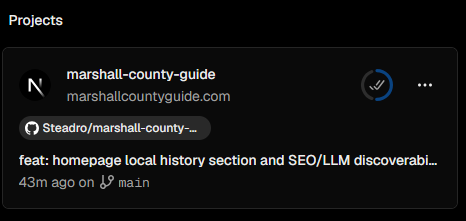
marshallcountyguide.com), good for two years, bought through name.com (any registrar works). - $20/month for Vercel. This is where the site lives: I push code to GitHub, Vercel builds it and serves it to the world. If any of that is unfamiliar, don't sweat it, open a new chat with Claude and have it walk you through. The "explain it like I'm in high school, then like I'm a college grad" trick is a great way to come up to speed on anything.
That's the budget. Forty dollars to start, twenty a month to keep the lights on, for a real site with a real database.
A wild Claude Design appears
One of the newer tools in the Claude lineup is Claude Design, which turns prompts into design work, from logos to full site layouts.
Here I'll break from the evangelizing: I'm genuinely uneasy about AI as a design tool. Something about human creation feels sacred to me, digital or physical. That's a lifetime spent around designers, and being married to a print-maker.
Is that hypocritical, given how freely I lean on Claude Code? I don't think so. Code is rooted in logic and rules; it has a right answer you can test. Design is a different world. It's taste, and taste is the part I think should stay human.
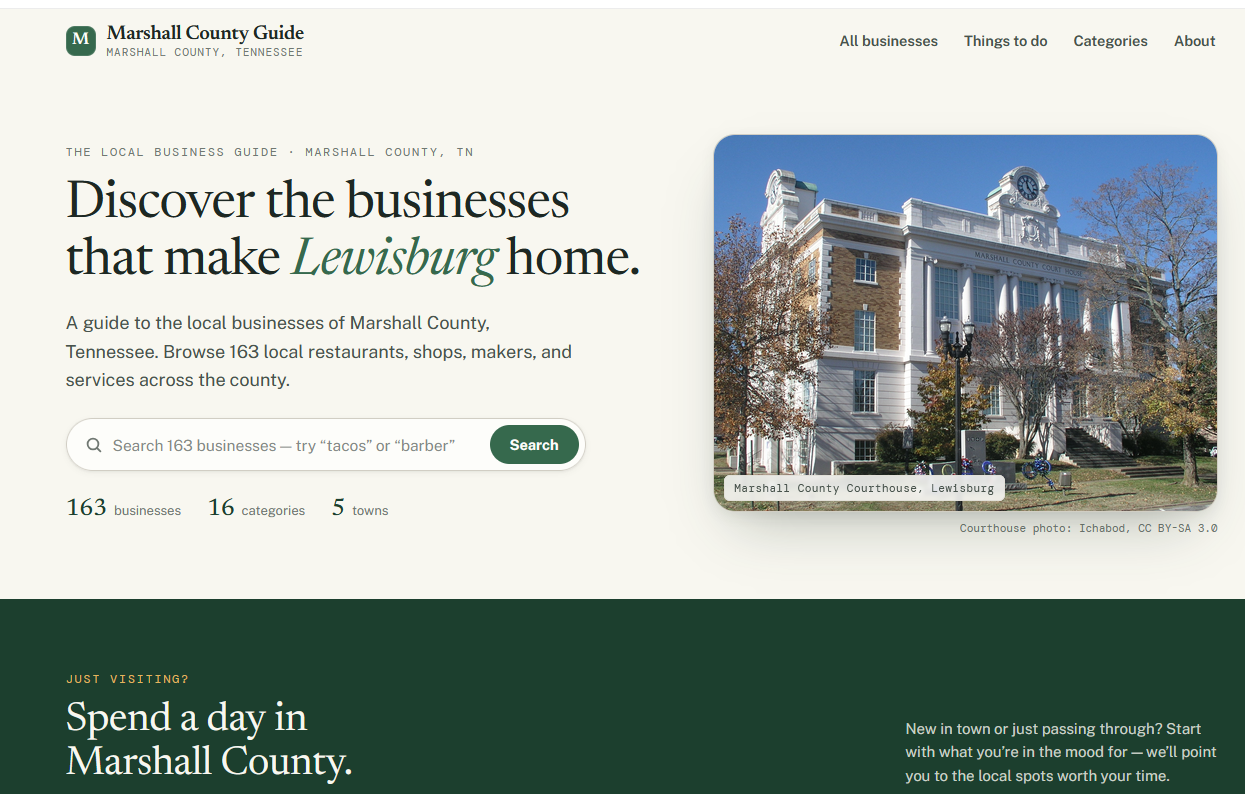
So I split the difference. I used Claude Design to reskin the site and find a better color palette. I stopped short of logos, branding, anything that defines the identity. Execution, yes. Identity, no.
Using Claude Design works like everything else here: you talk to it. I explained the goal, pointed it at the live site so it could see what I had, and named my actual gripe (too much BROWN). It came back with three or four directions. I realized I liked the site as it was; I just wanted a slightly livelier color palette. So, same as the spec handoff, I had it write up the changes and dropped that into the same project folder.
It's Alive! Scheduled work keeps new businesses flowing
Here's the payoff for starting in Cowork. It has a feature called scheduled actions that lets me set the directory running on a timer: every so often, Cowork goes out, finds businesses I haven't catalogued yet, researches each one, and drafts it into a file. A small automation on my machine notices that file and pushes it live within minutes. Find, research, publish, no hands.
I also borrowed an idea from Star Citizen: a data-quality tier I call "Gold Standard." Once a business has enough high-confidence detail behind it, its listing earns a gold marker, a quiet signal to visitors that we're sure about what they're looking at. So the directory doesn't just stay current on its own, it gets more trustworthy on its own too.
What this actually demonstrates
I'm not going to tell you software is dead or that nobody needs developers. What I'll tell you is narrower and more useful: a person who can think clearly about what they want can now get a real, working, deployed thing built in a weekend, for the price of a couple of lunches, by pointing the right tools at the right parts of the job.
The skill that mattered wasn't coding. It was planning before building, writing the plan down, starting the data simple, and handing each part of the job to the tool suited for it. That's learnable. That's the whole point of writing this.
This is the kind of thing I do at Steadro: help people figure out where these tools actually pay off, then build the thing. If you've got an idea sitting in a drawer because building it felt out of reach, that's the conversation I like having. Get in touch.
See the site: marshallcountyguide.com